 |
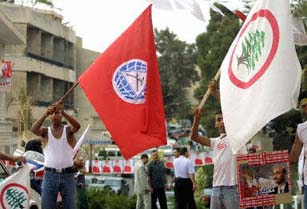
Lebanese youths carry the flags of the Progressive Socialist Party (L) and Christian Lebanese Forces in the coastal town of Damour, south of Beirut, 03 August 2001 during the visit of Maronite Patriarch Nasrallah Sfeir. Sfeir started a historic visit to the Shouf mountains, south-east of Beirut, aimed at reconciling Druz Muslims and Christians after years of hostility and massacres. It is the first time for 200 years that a Maronite patriarch visits the shouf, according to the secretariat of the Maronite Patriarchate. |
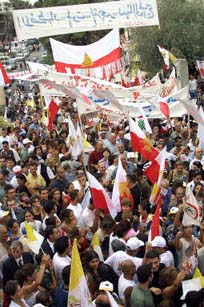 |
Lebanese gather in the coastal town of Damour, south of Beirut, 03 August 2001 during the visit of Maronite Patriarch Nasrallah Sfeir. Sfeir started a historic visit to the Shouf mountains, south-east of Beirut, aimed at reconciling Druz Muslims and Christians after years of hostility and massacres. It is the first time for 200 years that a Maronite patriarch visits the shouf, according to the secretariat of the Maronite Patriarchate. |
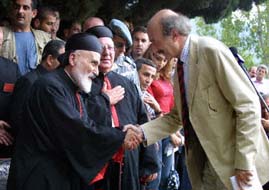 |
Maronite patriarch Nasrallah Sfeir (L) shakes hands with Walid Jumblatt, leader of the Druz community, during his visit to the village of Mukhtara, in the Shouf mountains, 04 August 2001. Lebanese President Emile Lahoud said that he hoped Sfeir's 'historic' trip to this region to reconcile Druz and Christians would hasten the return of Christian refugees ousted in 1976. |
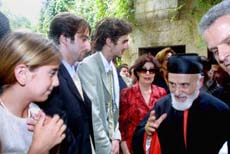 |
Maronite patriarch Nasrallah Sfeir (R) is welcomed by the children and mother of Walid Jumblatt, leader of the Druz community, during his visit to the village of Mukhtara, in the Shouf mountains, 04 August 2001. Lebanese President Emile Lahoud said that he hoped Sfeir's 'historic' trip to this region to reconcile Druz and Christians would hasten the return of Christian refugees ousted in 1976. |
by Salim Yassine
MUKHTARA, Lebanon, Aug 4 (AFP) - "Allow me to proclaim that the era of fratricidal wars between Lebanese is over for ever." It was with these words that Druze leader Walid Jumblatt greeted Christian Maronite patriarch Nasrallah Sfeir at his fief here Saturday, surrounded by some 10,000 supporters.
Under the shade of a 300-year-old cyprus tree, Druze and Christian religious leaders gathered alongside Christian party officials, ministers and deputies, while the crowd cheered for Sfeir, the head of the main Christian community in Lebanon. The cardinal was visibly moved by the Druze leader's words, replying "now the time has come for forgiveness and reconciliation."
He described the inter-communal conflicts in Lebanon as "crises of adolesence which have now disappeared as the Lebanese nation has rediscovered its unity." He called for the building of "a sovereign Lebanon, crowned by democracy and freedom, without which the country cannot survive." The Maronite patriarch began an historic three-day visit Friday to the Shouf mountains to help seal the reconciliation of the two communities, torn apart by generations of strife.
Their feuding dates back to the 19th century but reerupted with brutality during Lebanon's 1975-1990 civil war. The worst period was the 1985 "mountain war" which resulted in the exodus of more than 150,000 Christians and the destruction of dozens of villages.
On the thorny issue of Syrian-Lebanese relations, the patriarch, who wants the Syrian army to pull out of Lebanon, delivered a moderate speech in which he simply called for respect of the independence and sovereignty of Lebanon. Jumblatt was more direct and said that "balanced relations, which still respect the sovereignty of Lebanon, will serve the interests of both countries." He stressed that "Lebanon must take into account the strategic interests of Syria with regards to the threat posed by Israel."
Jumblatt, a traditional ally of Damascus, has recently drawn closer to the anti-Syrian Christians. His opposition to dominance by Damascus and support for the patriarch's call for a redeployment of Syrian troops, won him much stead in Christian circles.
The patriarch praised "the historic role of the Jumblatt family" and recalled that Kamal Jumblatt, Walid's father, "was murdered for his patriotic stance." Kamal Jumblatt was strongly opposed to Syrian troops entering Lebanon in 1976 and was murdered some months later.
Travelling along the winding green roads adorned with Vatican colours and showered with banners of Jumblatt's Progressive Socialist Party, Sfeir then headed for the Christian town of Jezzin -- known as the gate to southern Lebanon -- where he celebrated open-air mass with several thousand faithful.
In his sermon, he said he "would have liked to visit the residents of southern Lebanon, but sadly many of them, of different faiths, have chosen to leave or are suffering in jail. We know that their families also suffer in silence and deserve our compassion."
Sfeir was referring to some 6,000 Lebanese who fled to Israel during the tense period surround Israel's withdrawal from the region in May 2000 and to some 3,000 others who were jailed for "collaborating with the Israeli enemy." Sfeir was criticised by the pro-Syrian Shiite parliament speaker Nabih Berri for not including southern Lebanon in his trip.
BEITEDDINE, Lebanon, Aug 4 (AFP) - Lebanese President Emile Lahoud said Saturday he hoped Maronite patriarch Nasrallah Sfeir's "historic" trip to this region to reconcile Druze and Christians would hasten the return of Christian refugees ousted in 1976.
"This is a historical visit," said Lahoud after receiving Cardinal Sfeir, head of Lebanon's largest Christian community, at the mountainous 19th century Beiteddine Palace at the heart of the Shouf district east of Beirut. "We hope that it will help speed up the operation of the return of the refugees to their villages and for the closure of this file," Lahoud said in a statement.
Sfeir's visit to the Shouf was the first by a Maronite patriarch in 200 years. The region witnessed massacres perpetrated by Palestinian and leftist Lebanese militias that forced tens of thousands of Christians to flee a year after the outbreak of the 1975-1990 civil war. Many of those people have still not returned.
Lahoud "hailed the atmosphere of reconciliation that prevailed during the patriarch's visit because this will help reinforce the unity of the Lebanese." Lahoud, a Maronite himself, and Sfeir have often been at odds since the patriarch became one the strongest critics of Syria's military presence in Lebanon and its political dominance over its smaller neighbour. Sfeir, as part of his three-day tour to reconcile the feuding Druze and Christian communities, was due later Saturday to visit the Christian town of Deir al-Kamar.
He is also scheduled to visit the Mukhtara fiefdom of Walid Jumblatt, the leader of the Druze community, whose faith is an offshoot of Shiite Islam. Jumblatt, once a close Syrian ally, and a foe of the Christians during the civil war, has angered Damascus since rallying recently with the Christians in calling for more balanced ties with Syria and for implementing a Syrian troop redeployment.
Also on Saturday, Sfeir will travel to the Christian district of Jezzin, administered until 1999 by the South Lebanon Army, the now-disbanded pro-Israeli militia. More than 200 people from there are currently serving jail terms, or have already done so, for collaborating with the Jewish state. Sfeir's plan to visit Jezzin, which will not continue on to the former Israeli-occupied border zone in southern Lebanon, was criticised by pro-Syrian Christian deputies and Muslim leaders.
 |
 |
|
|
|
[ Post It ] [ Real Estate ] |
[ Employment ] |
[ Intellicast Beirut Weather Report ]
[ Back to Lebanon.com Home Page ]
© 2001 AFP. All rights of reproduction and distribution reserved. All information displayed on this section (dispatches, photographs, logos) are protected by intellectual property rights owned by Agence France-Presse. As a consequence, you may not copy, reproduce, modify, transmit, publish, display or in any way commercially exploit any of the content of this section without the prior written consent of Agence France-Presse.
© 1995-2001 Lebanon.com Interactive- USA ,
All Rights Reserved.
For any comments or questions please e-mail
info@lebanon.com