SOLIDERE launched this year the second phase
of its land treatment program, as part of the heavy engineering works preparing the
reclaimed land for development.
The US$53 million contract signed to that effect, on January 25, 1999, with the US
Texas-based Radian International, a member of Dames and Moore Group, came at the
conclusion of a tendering process involving eight international contractors. The agreement
was desctibed by US commerce secretary William Daley as "a win-to-win for American
business and the Lebanese. It demonstrates Lebanon's ability to develop its infrastructure
and maintain a sustainable environment that improves the quality of life and promotes
economic growth and stability in the region". |
|

Contract signing at the US Department of Commerce

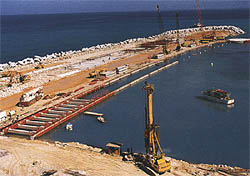
An 18-hectar area of land to be treated by Radian
|
| Covering the treatment of an
18-hectar area, the works include the excavation of around 5 million cubic meters of
demolition and waste material which will be separated by the sorting plant into its
various constituents, resulting in a reduced volume of material to be treated. The
contract will involve construction, waste treatment and laboratory testing. The project is
set to be completed in four and half years. The notice to proceed, expected by mid-April
1999, will be followed by a two-month mobilization period, with th efinal testing of the
sorting plant proceeding in parallel.
As the project marks the most significant involvement of a
US company in hte reconstruction of Lebanon to date, secretary Daley remarked happily:
"This project means that the Americans are back... and we want to take part in the
reconstruction of this lively country". "What I have seen of reconstruction
fascinated me", he added, "because there is an unequaled will to rebuild, in a
better way, what had been destroyed".
Mr. Profido, Radian's International's senior vice
president, lauded the agreement as "truly a significant opportunity for Dames and
Moore Group. We are dedicated to not only helping Beirut reclaim its reputation and status
as the business capital of the Middle East, but also to bringing the 'can-do' attitude of
American business to the Lebanese/American relationship". |